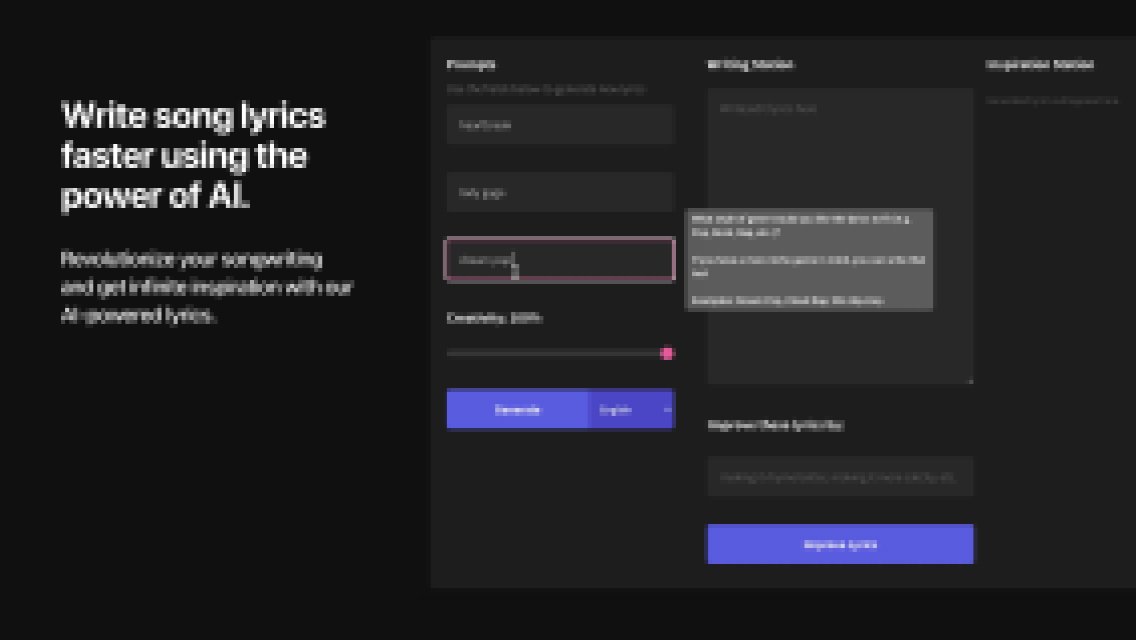
Every songwriter eventually stares down the daunting, blank page, a seemingly insurmountable wall between inspiration and execution. It's that moment when your guitar feels heavy, your piano keys seem to mock you, and every idea feels stale. But what if there was a secret arsenal of Alternative & Complementary Tools for Lyrical Inspiration, ready to shatter those creative blocks and unleash a torrent of fresh ideas? We're not talking about magic spells, but rather smart digital assistants that act as your co-conspirators in the craft of songwriting.
Forget the notion that using tools is "cheating." In today's creative landscape, the most successful artists leverage every available resource to enhance their expression, streamline their process, and discover new avenues of thought. Think of these tools not as replacements for your genius, but as powerful extensions of it – catalysts for the lyrical breakthroughs you’ve been chasing.
At a Glance: How Digital Tools Can Transform Your Lyrical Process
- Banish writer's block: Prompt generators offer unique themes and starting points for lyrics.
- Expand your vocabulary: Rhyming tools suggest words by syllable, sound, and popularity.
- Build musical foundations: Chord progression and drum machine tools help craft compelling backdrops for your words.
- Master music theory: Resources explain complex terms, enhancing your lyrical and musical understanding.
- Collaborate seamlessly: Share demos and gather feedback with timestamped comments for specific sections.
- Rapidly prototype: Algorithmic generators turn vocal ideas into full song structures.
- Refine and polish: Tools help you iterate on rhymes, meter, and overall lyrical flow.
- Stay organized: Manage project versions and ideas, keeping your creative flow smooth.
The Lyrical Labyrinth: Why We Get Stuck (and Why Tools Offer an Escape)
Writer's block isn't a personal failing; it's a natural ebb in the creative tide. Sometimes, you're too close to a subject, or perhaps you've exhausted your usual wells of inspiration. You might have a melody but no words, a compelling story but no hook, or a great concept that just won't translate into poetic verse. This is where alternative and complementary tools step in, offering a fresh perspective or a much-needed push.
These aren't just gadgets for the tech-savvy; they're designed for any songwriter looking to diversify their creative approach. They can help you:
- Generate Novel Concepts: Break out of predictable themes.
- Overcome Word Fatigue: Find new ways to say familiar things.
- Structure Your Ideas: Give form to abstract thoughts.
- Bridge Music and Lyrics: Ensure your words perfectly complement your melody.
- Refine and Polish: Turn good ideas into great lyrics.
By embracing these technologies, you're not just finding shortcuts; you're expanding your creative toolkit, making the songwriting process more organized, collaborative, and, crucially, more enjoyable.
Your Digital Muse: Exploring Alternative Inspiration Generators
The journey of a thousand lyrics often begins with a single word or idea. For those moments when your mind feels like a barren desert, a diverse range of inspiration generators can act as a sudden downpour, cultivating fertile ground for your next lyrical masterpiece.
Overcoming the Blank Page with Concept Starters
Imagine having a brainstorming partner who never tires and always offers a unique perspective. That's essentially what Song Topic, Song Idea, Songwriting Prompt, and Song Concept Generators provide. These aren't just pulling random words out of a hat; they're designed to kickstart your imagination by suggesting specific themes, intricate stories, character sketches, or compelling starting points you might never have considered.
Need to write a song about a forgotten letter found in a dusty attic? Or perhaps a conversation between two strangers on a late-night train? These generators can deliver prompts spanning genres and emotional landscapes, pulling you out of your comfort zone and into new narrative territories. It’s particularly useful when you have a general mood or melody, but no concrete lyrical hook. For instance, if you're stuck on a love song, a generator might suggest "the bittersweet memory of a first kiss under streetlights," immediately providing a tangible scene to build upon. This focused specificity often proves more effective than vague prompts, as it grounds your abstract musical ideas in concrete imagery. You might also find endless creative possibilities with our random song word generator, perfect for sparking unexpected lyrical juxtapositions.
Beyond Simple Prompts: Deeper Dive into Lyrical Augmentation
Once you have an initial idea or even a rough draft, the true craft of lyric writing begins. This often involves finding the perfect words that not only convey meaning but also possess the right rhythm, rhyme, and emotional weight. This is where specialized tools excel.
A sophisticated rhyming tool, for example, is far more than a simple dictionary of rhyming words. These resources often list possible rhymes by syllable count, categorize near rhymes, allow for meter restrictions, and even display word popularity. This level of detail empowers you to:
- Avoid cliché: Instead of obvious rhymes, discover fresh, unexpected pairings.
- Maintain flow: Ensure your chosen words fit the natural rhythm and meter of your melody.
- Expand your vocabulary: Stumble upon evocative words you might not have considered, broadening your expressive range.
- Refine meaning: Sometimes a "near rhyme" can subtly alter the nuance of a line, adding depth to your message.
Imagine you're trying to rhyme "heart" and are tired of "start" or "apart." A good tool might suggest "chart," "smart," "art," or even "carte," "marte," leading you down an entirely new lyrical path. It's about finding the best word, not just any word that rhymes.
The Songwriter's Digital Toolkit: More Than Just Lyrics
While direct lyrical tools are invaluable, inspiration for words often stems from the music itself. The chord progression, the rhythm, the very feel of a melody can dictate the narrative and emotional tone of your lyrics. Complementary tools that assist with the musical side of songwriting can therefore indirectly—but powerfully—boost your lyrical output.
Understanding the Language of Music
To write truly integrated songs, a basic understanding of music theory is incredibly beneficial. For songwriters who haven't formally studied music, a dedicated music theory resource can be a game-changer. These resources define terms like coda (the concluding passage), triad (a three-note chord), glissandi (a slide between notes), and crescendi (a gradual increase in loudness).
Knowing these terms aids in:
- Communication: Articulating your musical ideas more clearly to collaborators.
- Structure: Understanding how different musical sections (verse, chorus, bridge) function and relate to each other, which in turn informs your lyrical structure.
- Emotional Arc: Recognizing how musical dynamics and chord choices influence the emotional journey of a song, allowing your lyrics to mirror or contrast these feelings effectively. For instance, a diminuendo (gradual decrease in loudness) might inspire lyrics about fading hope or quiet reflection.
This foundational knowledge helps you build a more cohesive and professional song, where lyrics and music aren't just placed side-by-side but are interwoven, each enhancing the other.
Crafting Compelling Musical Beds for Your Words
Many songwriters find their lyrical inspiration by humming a melody or tinkering with chords. When that well runs dry, or you're looking for something fresh, these tools can provide the spark.
Hook Theory's popular chord progressions tool is essentially an encyclopedia of what makes successful songs tick. It provides clips and breakdowns of chords used in countless choruses, verses, and bridges across various genres. By analyzing and experimenting with these proven structures, you can:
- Find inspiration for a new song's musical backbone: Hear what works and adapt it.
- Understand emotional resonance: Learn how certain progressions evoke specific feelings, helping you match your lyrical intent with musical mood.
- Break out of repetitive patterns: If you always use the same four chords, this tool can introduce you to new, compelling sequences that will naturally lead to different lyrical ideas.
Similarly, Chordbot is a detailed tool for creating chord progressions and song ideas from scratch. It allows you to build sequences across various keys and instruments (pianos, synths, acoustic guitar) and even add effects. You can export these as MIDI, WAV, or Chordbot projects for collaboration. This hands-on approach to chord creation can be incredibly stimulating for lyricists. By building a rich, dynamic harmonic structure, you create a powerful canvas that almost demands specific types of lyrical narratives or emotional expressions.
And for those who sing first and write later, an algorithmic generator that transforms sung vocals into full songs in styles like R&B or Classical offers a revolutionary approach. You sing a simple melody, and the tool builds an entire instrumental arrangement around it. This facilitates rapid melodic idea development and lets you hear your raw vocal idea in a fully realized musical context, which can then inspire the lyrics to fit that new soundscape. It's like having an instant arranger and producer at your fingertips, turning a fleeting hum into a potential hit.
Rhythm and Structure: The Beat Beneath Your Words
Lyrics need rhythm, and often that rhythm is born from or influenced by the accompanying beat. Exploring drum patterns can unlock a new sense of cadence for your verses and choruses.
iO808, a classic 808 drum machine emulator, allows you to plot, play along to, record, and save rhythms. For a lyricist, experimenting with different drum patterns can:
- Influence syllable count and meter: A fast, intricate beat might push you towards shorter, punchier lines, while a slower, more open groove might invite longer, more reflective phrases.
- Inspire lyrical themes: A dark, driving beat might suggest lyrics about tension or struggle; a light, syncopated rhythm could spark tales of joy or dance.
- Create a sense of "pocket": When your lyrics lock into a groove, they feel more natural and impactful.
For more comprehensive demoing and multitracking, Audiotool emulates analog production, letting you patch virtual instruments and effects via cables. This hands-on approach helps you understand signal flow and allows you to build entire hip-hop or electronic projects. By actively participating in the instrumental creation, you'll gain a deeper understanding of the song's energy and texture, which can directly inform your lyrical choices, helping you create words that truly fit the sonic world you're building. You can even experiment with our random song word generator to layer unique, unexpected elements into your tracks.
Streamlining Your Process: Collaboration and Refinement
Songwriting is rarely a solitary endeavor, and even when it is, the iterative process of drafting and refining benefits immensely from external perspectives and specialized tools.
Collaborative Creativity
Receiving constructive feedback is crucial for honing your lyrics. LANDR Collaboration facilitates this by allowing you to share private links to demos or mastered tracks. Crucially, it lets you collect feedback with timestamps for specific sections. This means a collaborator can point out a weak line in the second verse or suggest an alternative rhyme in the chorus with pinpoint accuracy.
For a lyricist, this targeted feedback is gold. Instead of vague "I like it" or "it needs work," you get actionable insights like: "That metaphor in line 3 of the bridge feels forced here at the 1:45 mark," or "Could we try a different word for 'lonely' in the chorus?" This not only improves the final product but can also spark new lyrical ideas as you consider different interpretations and suggestions. It also helps manage project versions, so you can track changes and revert if needed, maintaining a clear evolution of your lyrical and musical ideas.
Refining Your Rhymes and Meter
Once you have a solid lyrical draft, the next step is often polishing. This means ensuring your rhymes aren't just technically correct, but also compelling and natural. Revisit those rhyming tools you used for initial brainstorming, but now with a critical eye for refinement.
- Check for predictability: Are your rhymes too obvious? A tool can suggest more surprising alternatives.
- Ensure meter and flow: Does the rhythm of your words align with the music? Adjusting syllable count or word choice can make a line sing.
- Strengthen imagery: Is there a stronger, more evocative word you could use that still fits the rhyme scheme?
This iterative process of drafting, getting feedback, and refining with the help of specialized tools is how good songs become great. It's about finessing every word to carry its maximum impact. Need a fresh angle for a recurring phrase? Our dynamic word generator can help you brainstorm variations that maintain your core meaning while adding new texture.
Best Practices for Integrating Tools into Your Workflow
These tools are powerful, but like any instrument, they require a thoughtful approach to truly unlock their potential.
- Don't Replace, Enhance: These tools are not meant to write the song for you. They are designed to assist your creative process, spark new ideas, or refine existing ones. Your unique voice, experiences, and perspective remain the core of your songwriting.
- Experiment Widely: Don't limit yourself to just one type of tool. Try a prompt generator one day, a chord progression tool the next, and a rhyming dictionary later. Mix and match to see how different combinations affect your creative flow.
- Use Tools as Launchpads, Not Finishing Lines: A generated prompt is a starting point, not the finished lyric. A suggested rhyme is an option, not a mandate. Always filter the output through your own artistic sensibilities and adapt it to fit your song's unique narrative and emotional landscape.
- Set Time Limits for Exploration: It's easy to get lost in the endless possibilities these tools offer. If you're using a prompt generator, give yourself 15 minutes to find something compelling, then switch to writing. If you're exploring chord progressions, set a timer for 30 minutes to avoid analysis paralysis.
- Keep a "Swipe File" of Generated Ideas: Not every idea a tool spits out will be useful immediately, but it might be perfect for a future song. Maintain a digital or physical "swipe file" where you save interesting prompts, evocative word combinations, or intriguing chord sequences for later use.
Common Misconceptions About AI and Tools in Songwriting
The rise of digital tools and artificial intelligence in creative fields often brings with it skepticism and misconceptions. Let's address some of the most common ones surrounding songwriting tools.
- "It's cheating; a real songwriter doesn't need these."
This is perhaps the most prevalent misconception. Think of these tools like a dictionary, a thesaurus, a guitar tuner, or even a session musician. They are aids. Beethoven used paper and pen; modern composers use notation software. The tool changes, but the core act of creation remains with the human artist. These tools simply expand your palette and help you navigate creative obstacles more efficiently. - "It makes all songs sound the same."
This couldn't be further from the truth. A prompt generator, for instance, offers a starting point. How you interpret that prompt, what personal experiences you weave into it, what musical style you choose, and what emotional depth you impart—that's what makes the song unique. The tools provide ingredients; you, the songwriter, are the chef. In fact, by exposing you to ideas you might not typically generate, these tools can actually foster greater originality, pushing you into new, uncharted lyrical territory. Using our powerful random song word generator might even help you craft unexpected and truly unique lyrical combinations. - "It kills originality."
Originality comes from the unique combination of elements and your distinct perspective. If anything, these tools can unlock originality by providing diverse prompts and resources that help you break free from your habitual thought patterns. If you always write about lost love, a tool might suggest a sci-fi narrative, forcing you to develop new vocabulary and imagery. This challenge can lead to highly original and unexpected lyrical breakthroughs. - "It's soulless; creativity has to be purely organic."
Creativity is a complex process. While inspiration often strikes organically, the craft of turning that inspiration into a finished piece of art is often a deliberate, iterative, and sometimes arduous process. Tools can inject moments of spark and ease the technical burdens, allowing you more mental space to focus on the emotional core and "soul" of your song. The soul of the song ultimately resides in the songwriter's intent and execution, not in whether a digital helper was used along the way.
Moving Beyond the Block: Your Next Steps
The journey of songwriting is continuous, filled with peaks of inspiration and valleys of frustration. But armed with the right alternative and complementary tools, those valleys can become much shallower and shorter. These technologies are here to enhance your creative expression, making the songwriting process more organized, collaborative, and, most importantly, more enjoyable.
So, where do you begin? Pick one tool that resonates with you from the descriptions above—perhaps a prompt generator to kickstart a new idea, or a rhyming tool to refine a struggling verse. Experiment. Play. Treat these digital assistants as your creative partners, ready to offer a helping hand whenever the muse seems distant. Embrace the possibilities, and watch as new lyrical landscapes unfold before you. The next great song is waiting to be written, and these tools are here to help you find the words. You might find a whole new world of lyrical possibilities by exploring our powerful random song word generator today.