Harmonizing with Algorithms: Exploring the Benefits and Limitations of AI & Word Generators for Lyrics
In an era where artificial intelligence is reshaping industries from healthcare to art, it’s no surprise that the creative world of songwriting is also experiencing its transformative touch. Specifically, the rise of AI & word generators for lyrics has sparked both excitement and apprehension among artists. Can a machine truly capture the raw emotion, intricate storytelling, and nuanced poetry of human expression? Or does it merely offer a sophisticated scaffold, a starting point for our uniquely human creative journey? This guide dives deep into the Benefits and Limitations of AI & Word Generators for Lyrics, offering a comprehensive look at how these digital muses function, where they excel, and where human ingenuity remains irreplaceable.
At a Glance: AI Lyrics & Your Creative Process
- What they are: Digital tools powered by AI (NLP, machine learning) that generate lyrics based on your input (themes, moods, keywords).
- Key Benefits: Speed up drafting, inspire new ideas, adapt to various genres and languages, build confidence for beginners, and reduce costs.
- Core Limitations: Often lack deep emotional resonance, require significant human editing, present copyright complexities, and some are genre-specific.
- Best Practice: Treat AI as a creative partner, not a replacement. Be specific with prompts, iterate through drafts, and always infuse your personal touch.
- Future Outlook: Expect more precision, emotional intelligence, and even melody integration, but human creativity will remain central.
The Algorithmic Muse: Understanding AI & Word Generators for Lyrics
Imagine a digital collaborator that never sleeps, never runs out of ideas, and has "read" every song lyric ever written. That's the essence of an AI lyrics generator. These sophisticated tools leverage Natural Language Processing (NLP) and machine learning, trained on immense datasets of text, including countless song structures, rhyme schemes, and thematic patterns.
When you feed them a prompt – a mood, a genre, a few keywords – they don't just randomly pick words. Instead, they predict word sequences, suggest rhymes, expand your vocabulary, and strive for contextual coherence, all with the goal of producing original lyrics, verses, choruses, and hooks. For many musicians, especially those grappling with writer's block, these generators are becoming an indispensable creative partner, a way to jumpstart a session or explore lyrical avenues they might not have considered otherwise.
The Harmony: Unpacking the Benefits of AI Lyric Tools
Let's be clear: AI isn't here to steal your spotlight. It's here to empower it. When wielded effectively, these tools offer a compelling array of advantages that can significantly enhance your songwriting process.
Accelerating Your Creative Flow
One of the most immediate and appreciated benefits is sheer efficiency. Traditional lyric writing can be a painstaking process, demanding hours of brainstorming, drafting, and refining. AI generators cut through much of this, spitting out initial drafts, verses, or hooks in mere seconds. This speed allows you to experiment with many more ideas in a fraction of the time, making your creative sessions far more productive. Whether you're under a deadline or simply eager to explore numerous lyrical concepts quickly, AI acts as a turbocharger for your workflow.
Unlocking Fresh Inspiration
Every songwriter knows the frustrating wall of writer's block. You have a melody, a feeling, a concept, but the words just won't come. This is where AI truly shines as an inspirational spark. By providing starting points, unexpected word combinations, or novel angles on a theme, these tools can jolt your creativity back to life. Think of it as having a brainstorming partner who never judges and always has a suggestion, no matter how wild. It helps you explore new forms of expression you might not have found on your own, pushing the boundaries of your typical lyrical comfort zone. Sometimes, just seeing a phrase or a rhyme can unlock an entire verse in your mind.
Adapting to Every Sound and Story
Modern music is incredibly diverse, and your lyrical tool should be too. AI lyrics generators offer remarkable versatility, adapting to multiple music styles, genres, and customizable tones. Whether you're crafting a melancholic folk ballad, an upbeat pop anthem, a gritty rap track, or a hard-hitting rock song, you can often guide the AI to match the desired vibe. Many also support multi-language generation, opening up possibilities for artists targeting global audiences or exploring lyrical themes in different tongues. This adaptability makes them a valuable asset regardless of your musical niche.
Leveling the Lyrical Playing Field
For aspiring songwriters, the blank page can be intimidating. AI tools offer greater accessibility, boosting confidence for beginners who are still finding their voice. By providing structured examples and suggestions, they can help new artists understand song structures, rhyme patterns, and thematic development. For seasoned professionals, they serve as an excellent brainstorming tool, quickly generating variations or exploring alternative phrasing for complex ideas. It's a supportive environment for anyone looking to refine their craft, regardless of their experience level.
Real-Time Creative Partnerships
Some advanced AI tools are moving beyond simple generation, offering features designed for collaboration. Imagine working on a song with a human co-writer across different locations, and an AI tool sits in, providing suggestions in real-time, helping bridge creative gaps, or offering a third perspective. While this feature is still evolving, it hints at a future where AI acts as a seamless extension of your creative team, facilitating co-creation and streamlining the feedback loop.
Budget-Friendly Brainstorming
Creativity shouldn't come with a prohibitive price tag. Many AI lyrics generators, particularly basic ones, offer cost-effective solutions. There are numerous free options available, making them accessible to independent artists and those on a tight budget. Even paid subscriptions for more advanced tools are often quite affordable, significantly reducing the creative costs associated with traditional songwriting and allowing more resources to be allocated to production or promotion. If you're looking for quick inspiration, even a basic random song word generator can provide a useful spark without breaking the bank.
The Dissonance: Navigating the Limitations and Ethical Considerations
While the benefits are clear, it's crucial to approach AI lyrics generators with a discerning eye. They are tools, not sentient beings, and their limitations remind us that the human element remains paramount.
The Indispensable Need for Quality Control
Perhaps the most significant limitation is quality control. AI-generated lyrics, while often impressive, rarely emerge perfect. They frequently require manual adjustment, optimization, or editing to fully align with your precise artistic intent, personal style, or to avoid repetition. The AI might generate clever rhymes but sacrifice thematic coherence, or produce phrases that sound good but lack emotional depth. Expect to treat AI output as a rough draft, a foundation upon which you, the artist, will build the true masterpiece. Your unique voice and perspective are essential filters.
The Elusive Nature of Emotional Depth
AI can mimic feelings. It can pull phrases associated with joy, sorrow, anger, or love from its vast training data. However, it fundamentally lacks the emotional depth and lived experience of human emotion. A human songwriter pours personal experiences, triumphs, heartbreaks, and philosophical insights into their words. An AI cannot feel the sting of betrayal or the warmth of true love; it can only process and recombine linguistic patterns associated with these feelings. This often results in lyrics that feel superficial, generic, or devoid of the raw vulnerability that connects with an audience on a profound level. Injecting that authentic human touch is entirely your responsibility.
Copyright Complexities in the Digital Age
The question of copyright is a significant grey area for purely AI-written lyrics. Current legal frameworks, particularly in jurisdictions like the US, often require human authorship for intellectual property protection. If a piece of music or a lyrical work is generated solely by an AI without substantial human creative input and editing, it may not be copyrightable on its own. This means that for your lyrics to be legally protected and truly yours, human editing and creative intervention are not just beneficial for quality, but essential for intellectual property protection. Always assume you need to contribute significantly to make it your own.
Specialization and Its Constraints
While some tools boast versatility, others have a clear specialization. DeepBeat, for instance, is highly optimized for rap and hip-hop. While this can be a strength for artists in those genres, it means the tool may offer limited support or produce less compelling results for other styles like country, classical, or rock. If your chosen AI generator is too genre-specific, you might find its output doesn't quite capture the nuances of your preferred musical landscape, requiring even more manual adjustment.
The Cost of Advanced Innovation
While free options exist, the most advanced features and robust capabilities of AI lyrics generators are typically locked behind paid subscriptions. These premium tiers often offer unlimited generations, more sophisticated suggestion algorithms, better contextual understanding, and priority support. For independent artists with limited budgets, balancing the desire for advanced tools with financial constraints can be a consideration. While the investment can be worthwhile for increased efficiency and feature sets, it's a factor to weigh against the creative gains.
From Prompt to Poem: Mastering AI Lyrics Generation
Think of AI lyrics generators not as automated lyricists, but as sophisticated suggestion engines. The real magic happens when you, the human, master the art of prompting and refining their output. Here's how to turn algorithmic suggestions into authentic artistry.
The Art of the Prompt: Specificity is Key
Generic input yields generic output. To get truly useful results from an AI generator, you need to be specific with your prompts. Instead of simply typing "love song," try "summer love under city lights, feeling bittersweet and nostalgic." Include details about:
- Mood: Happy, sad, angry, hopeful, melancholic.
- Genre: Pop, rock, folk, hip-hop.
- Theme: Lost love, new beginnings, social commentary, nature.
- Setting: A specific place, time of day, or atmosphere.
- Perspective: First person, third person, a character's voice.
The more context you provide, the better the AI can align its output with your vision. It's like guiding a sculptor rather than just telling them "make something nice."
Strategic Collaboration: Hooks vs. Verses
Sometimes, the best approach is to leverage the AI for specific parts of your song. Many artists find it effective to consider writing the hook yourself and letting AI suggest verses. Your hook is often the emotional core, the most memorable part, and where your unique voice needs to shine brightest. Once you have that solid anchor, you can use the AI to flesh out the narrative or descriptive verses around it, providing context, imagery, and supporting ideas. Conversely, you might use AI to brainstorm a catchy hook, then build your verses manually. Experiment to find what works for your creative process.
Iterate and Refine: Combining the Best Lines
Don't settle for the first draft. Generate multiple drafts from your prompts and approach them like a treasure hunt. You'll likely find that one draft has a fantastic opening line, another has a compelling metaphor, and a third offers a perfect rhyme scheme. Your job is to combine the best lines and phrases from various outputs, weaving them into a cohesive and emotionally resonant whole. This iterative process ensures you're leveraging the AI's breadth of suggestions while maintaining your creative control.
The Human Touch: Personal Details, Emotions, and Flow
Remember that AI lacks lived experience. To elevate generated lyrics from generic to genuine, you must always edit for personal details, emotions, and flow.
- Personalize: Replace generic phrases with specific memories, unique metaphors, or personal anecdotes that only you can tell.
- Emotionalize: Infuse the words with genuine feeling. If a line feels flat, tweak it until it resonates with the emotion you want to convey.
- Ensure Flow: Read the lyrics aloud to check for natural rhythm and smooth transitions between lines and verses. AI sometimes prioritizes rhyme over natural conversational flow, which you'll need to correct.
Your unique story is your superpower; use the AI to help you tell it more effectively, not to tell it for you.
Read It Aloud: Matching Rhythm and Musicality
Lyrics are meant to be sung, not just read. A critical step in refining any lyrics, especially AI-generated ones, is to read them aloud to ensure they match the desired rhythm and musicality.
- Do the syllables flow naturally?
- Does the cadence align with your melody?
- Are there awkward pauses or tongue-twisters?
- Does it feel right when spoken or sung?
This auditory check is vital for ensuring your lyrics don't just look good on paper but also sound compelling when set to music.
Your AI Co-Writer Toolkit: A Closer Look at Popular Platforms
The landscape of AI lyrics generators is constantly evolving, with new tools emerging regularly. Here's a rundown of some prominent players and what they bring to the table:
LyricStudio
LyricStudio is designed as a focused creative assistant.
- Features: This platform is known for its contextual suggestions, offering rhymes and synonyms that actually make sense within your current lyrical context. It supports multiple styles and genres and boasts a "Magic Draft" feature that can generate entire verse and chorus sections. Paid plans provide unlimited generations, full copyright ownership for your creations, and advanced suggestion settings. The Gold Plan further enhances this with advanced metaphor/simile generation, improved context detection, intelligent lyric sentence completion, and functions to guide specific line-starting and ending phrases.
- Limitations: While "Magic Draft" is powerful, it doesn't generate full songs, meaning you'll still be assembling parts. Suggestions, while generally good, may sometimes deviate slightly from your preset styles, requiring a bit of correction.
- Pricing: A free trial is available. Pro Plan: $5.99/month (monthly), $4.99/month (6-month), $3.99/month (annual). Gold Plan: $9.99/month (monthly), $8.99/month (6-month), $7.99/month (annual).
ChatGPT
OpenAI's ChatGPT has become a household name for its conversational AI capabilities, which extend impressively into creative writing.
- Features: Highly adaptable, ChatGPT can be guided through user input to match a specific artistic vision. It excels at providing personalized creative suggestions and generating lyrics for a wide array of prompts, from simple themes to complex narratives. Its strength lies in its ability to follow detailed instructions and iterate on feedback.
- Limitations: The output often requires optimization and careful editing; while it can generate coherent text, it may occasionally not fully align with highly nuanced input topics or specific keywords without iterative refinement. Its "personality" is neutral, so you'll have to inject your own tone.
- Pricing: Free for its core features, though advanced access (like GPT-4) comes with a paid subscription.
DeepBeat
For those steeped in the rhythms of rap and hip-hop, DeepBeat offers a specialized experience.
- Features: This tool is tailor-made for rap and hip-hop creators, offering rich inspiration and clever rhyme suggestions optimized for these genres. It also supports multi-language lyric generation, which is a boon for artists in diverse linguistic environments.
- Limitations: Its primary focus on rap and hip-hop styles means its support for other genres is limited. If you're writing a folk song, DeepBeat might not be your best bet. Generated lyrics, while rhythmically sound, may still need adjustment for deeper thematic or emotional resonance.
- Pricing: Free.
Rytr
Rytr is a versatile writing assistant that includes lyric generation among its many capabilities.
- Features: Beyond lyrics, Rytr offers a suite of writing tools, but for songwriters, it provides multi-language lyric generation and highly customizable tone matching. This means you can specify if you want your lyrics to sound "optimistic," "witty," or "formal," and the AI will try to adhere to that.
- Limitations: As with many general-purpose tools, some of its more advanced features require a paid subscription. Also, its lyric output may still need significant adjustment to truly stand out.
- Pricing: Free trial. Unlimited Plan: $7.50/month. Premium Plan: $24.16/month.
Neural Frames: A Unique Niche
It’s important to clarify Neural Frames' role within this list. While sometimes mentioned in the context of AI tools for music creators, its primary functions are distinct from direct lyric generation.
- Core Features: Neural Frames is predominantly a powerful text-to-video generation and music-visual tool. It renders dynamic video from prompts, creates music-responsive animations where visuals pulse and morph with audio (tempo, volume, frequency, and isolated stems), and offers frame-level control for fine-tuning color, lighting, and camera motion. You can even train custom AI models with images for consistent visual styles and output broadcast-grade video up to 4K resolution. So, while it helps create the visuals for your song, it doesn't directly write the lyrics. It's a tool for the presentation of your song, not its lyrical composition.
- Pricing (Credit-based monthly plans): Neural Navigator ($19/month for 1,000 credits, 5 AI models, 1080p), Neural Knight ($39/month for 2,400 credits, 7 AI models, stem extraction, audioreactive, 1080p), Neural Ninja ($99/month for 7,200 credits, 10 AI models, stem extraction, audioreactive, 1080p, 4K), Neural Nirvana ($299/month for 24,000 credits, 10 AI models, stem extraction, audioreactive, 1080p, 4K, priority upscaling).
Other Noteworthy Tools: Quick Mentions
- These Lyrics Do Not Exist: Offers full songs with choruses based on chosen theme and mood, often with a unique, slightly surreal flair.
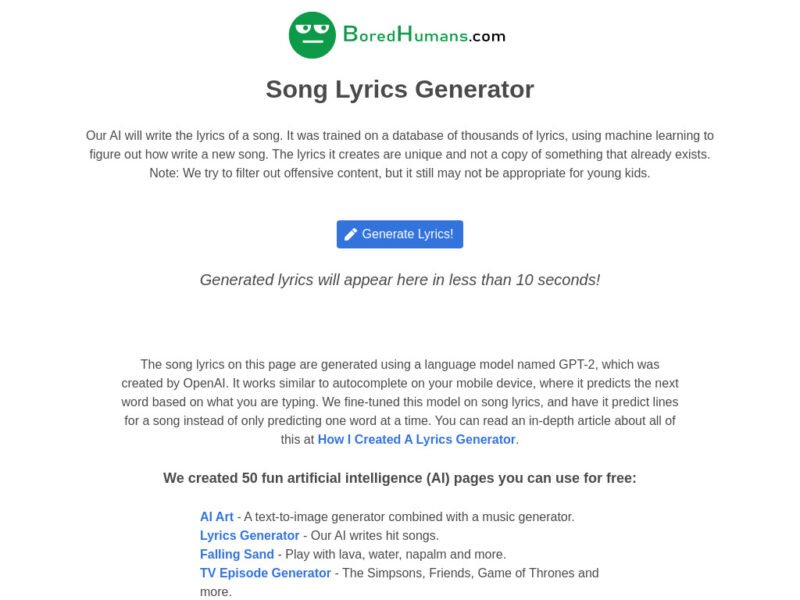
- BoredHumans Lyrics Generator: A free, fun tool for generating quirky and often humorous lyrics, great for quick laughs or unexpected ideas.
- LyricsGenerator.io: Allows selection of genres and moods for custom results, giving you more control over the output's tone.
- Suno AI: A rapidly emerging tool that goes beyond just lyrics, generating full songs including vocals and music from simple text prompts, pushing the boundaries of AI in music creation.
Beyond the Words: The Future of AI in Songwriting
The trajectory of AI lyrics generators is undeniably upward. We can expect these tools to become even more precise, offering suggestions that are not only contextually relevant but also emotionally intelligent, better at understanding and replicating nuanced human sentiment. Future advancements may include direct connections between generated lyrics and melodies, potentially leading to the creation of complete, ready-to-sing songs with both music and words harmonizing from the outset.
Imagine an AI that learns your unique songwriting style, anticipates your creative needs, and offers suggestions in your own artistic voice. AI could evolve into a truly collaborative "bandmate," contributing ideas, polishing phrases, and even handling some of the structural heavy lifting.
However, one truth will remain constant: human creativity will always be the irreplaceable core of songwriting. AI will enhance, streamline, and inspire, but it won't replace the spark of human experience, the depth of personal emotion, or the unique perspective that only a human artist can bring to their craft. The future isn't about AI replacing songwriters; it's about AI empowering them to reach new heights of expression.
Making AI Your Ally, Not Your Overlord: Actionable Steps for Songwriters
The journey with AI lyrics generators isn't about surrendering creative control; it's about embracing a powerful new tool. To truly leverage the benefits and navigate the limitations, consider these actionable steps:
- Embrace It as a Tool: View AI as an assistant, a brainstorming partner, or a well-informed editor, not a competitor. Your role as the primary creative force is secure and essential.
- Prioritize Your Unique Voice: Use AI to find new ways to express your story, your emotions, and your perspective. Never let the machine dictate the soul of your song. Your personal touch is what makes the lyrics resonate.
- Experiment Fearlessly: Try different generators, varied prompts, and unexpected combinations of AI output. The more you experiment, the better you'll understand its capabilities and how to bend it to your will.
- Practice the Art of Editing: Consider every AI-generated output as a first draft. Sharpen your editing skills, focusing on emotional depth, narrative coherence, rhythmic flow, and originality. This is where your craftsmanship truly shines.
- Stay Informed: The technology is evolving rapidly. Keep an eye on new tools and features. What's a limitation today might be a breakthrough tomorrow.
AI lyrics generators represent a fascinating frontier in music creation. They offer unprecedented efficiency, boundless inspiration, and accessible pathways for artists of all levels. By understanding their strengths, acknowledging their weaknesses, and approaching them with a human-first mindset, you can unlock a new realm of creative possibilities, letting the algorithms help you find the perfect words to paint your next sonic masterpiece.